
🧬 SNP-it: Personalized Health Recommendation Tool
Role: UX Researcher, Frontend Developer
Timeline: Jan 2025 – May 2025
Tools: React, FastAPI, Plotly, Dash, Google Forms, Figma
📝 Overview
SNP-it is a personalized health tech tool that delivers lifestyle recommendations based on either raw SNP data or a structured health questionnaire. It was built to make personalized health insights accessible, especially for users without a scientific background.
🎯 Problem Statement
Most wellness apps give generic advice that ignores personal genetics and behavior. SNP-it was created to explore how digital tools can make health recommendations more relevant by combining genomic data with lifestyle input.
👥 Target Audience
Health-conscious users, with or without access to their genetic data, seeking personalized insights about diet, mental health, and fitness.
🧠 UX Research & Design
📋 Input Modes
Users can either upload SNP data or complete a health questionnaire. The UI adapts dynamically to the selected mode for a smooth experience.

💬 Research & Feedback
To evaluate usability and comprehension, I ran a study with 32 participants (average age 27.8) who completed the full flow: questionnaire, optional genetic upload, and recommendation review, followed by a post-task survey scored using the System Usability Scale (SUS).
The platform scored an SUS of 84.6/100 (Grade A, "Excellent"), with 94% finding it easy to navigate and 91% finding recommendations easy to understand. A notable insight: while 96% said privacy was important to them, only 41% chose to upload genetic data versus 59% questionnaire-only, suggesting privacy concerns, not usability, were the main barrier to deeper engagement with the genetic features.
Users also flagged specific friction points: 22% wanted clearer SNP terminology, 19% were unsure which file to upload, and 16% wanted a progress indicator, while 53% reported no significant issues at all.
🔗 Mapping Logic
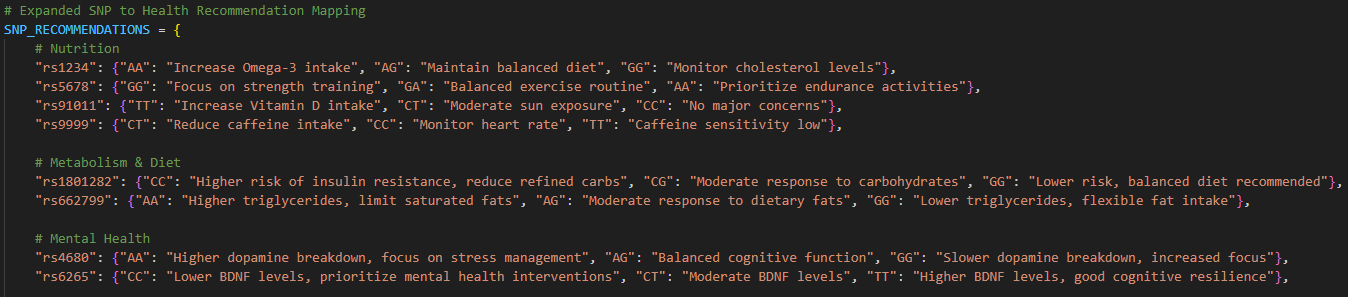
Each SNP or survey input was mapped to health insights (e.g., “Low folate processing → suggest leafy greens”) with color-coded impact levels.
💻 Technical Stack
Frontend: React with flexible components
Backend: FastAPI for processing and serving logic
Visualization: Plotly & Dash for dynamic data views
🌟 Key Features
🧬 Dual-input system: Upload genetic files or answer questions
📊 Color-coded insights: Based on strength of impact
💡 Plain-language summaries: Jargon-free recommendations
🗂️ Categorized results: Diet, mental health, physical activity
💾 Save progress: Questionnaire can be resumed later
📋From Findings to Design Changes
Based on this feedback, I made three targeted changes:
Redesigned the recommendation page with color-coded sections and supporting graphics, replacing a dense text block — directly addressing users who found the original page too text-heavy.
Expanded the food recommendation backend with a larger, more varied pool of suggestions so results don't feel repetitive across sessions — the most-requested improvement from users.
Added a downloadable results option, letting users save their recommendations locally, in response to requests for exportable reports.

💭 Reflection
Bridging UX with genomics challenged me to simplify complex data into helpful, actionable guidance. It taught me the importance of clarity and emotional design when working with personal health data.
🔮 Next Steps
Add user profiles, log-in functionality, and feedback loops to adjust recommendations over time, along with the top remaining user requests: clearer SNP terminology explanations, a progress indicator during the assessment, and mobile support.
📬 Let’s Talk
Want to see the live demo?
Let’s chat about health tech, personalization, or building ethical digital tools.
yani2x4@gmail.com